Booking a creator for every ad variation stopped penciling out once creative fatigue sped up on Meta and TikTok — many media buyers now plan for ten-plus fresh creatives a month as a working rule of thumb. AI spokesperson video — an avatar presenter delivering your hook to camera — now covers most of that volume. The math: an 8-second avatar-led clip on v4v runs 349 credits, about $2.44 at the $7 entry pack, with no subscription. Human creator clips are typically quoted in the hundreds of dollars each and take days. Subscriptions sit in between: HeyGen runs $29 to $149 a month with Avatar IV listed at 20 credits per minute; Synthesia starts at $29 a month for 120 video minutes a year (as of July 2026). The honest catch: avatars still lose on real testimonials and hero brand content. Use AI for volume, real people for trust.
- What Is an AI Spokesperson Video?
- Why Are Brands Switching in 2026?
- What Does It Replace — and What Doesn't It?
- How Does the Production Workflow Work Now?
- What Does It Cost Compared With Hiring Talent?
- Which Avatar Style Fits Which Ad?
- Where Does an AI Spokesperson Still Lose?
- How Do You Make It a Repeatable System?
- FAQs
- Start Generating
Hiring on-camera talent used to be the only way to put a face in a product ad. Find a creator, negotiate a rate, coordinate a schedule, wait a week, get one clip. Then do it all again, because the algorithm wants fresh creative and last month's ad is already fading.
That loop is breaking. A brand running paid social in 2026 needs ten or twenty ad variations a month, not three. At creator rates, that cadence eats the budget before the media spend even starts. AI spokesperson video fills the gap — and the output quality has crossed the line where it holds up on a phone screen at scroll speed.
Here's how the format works, what it replaces, what it genuinely can't do, and how to run it as a system instead of a one-off.
What Is an AI Spokesperson Video?
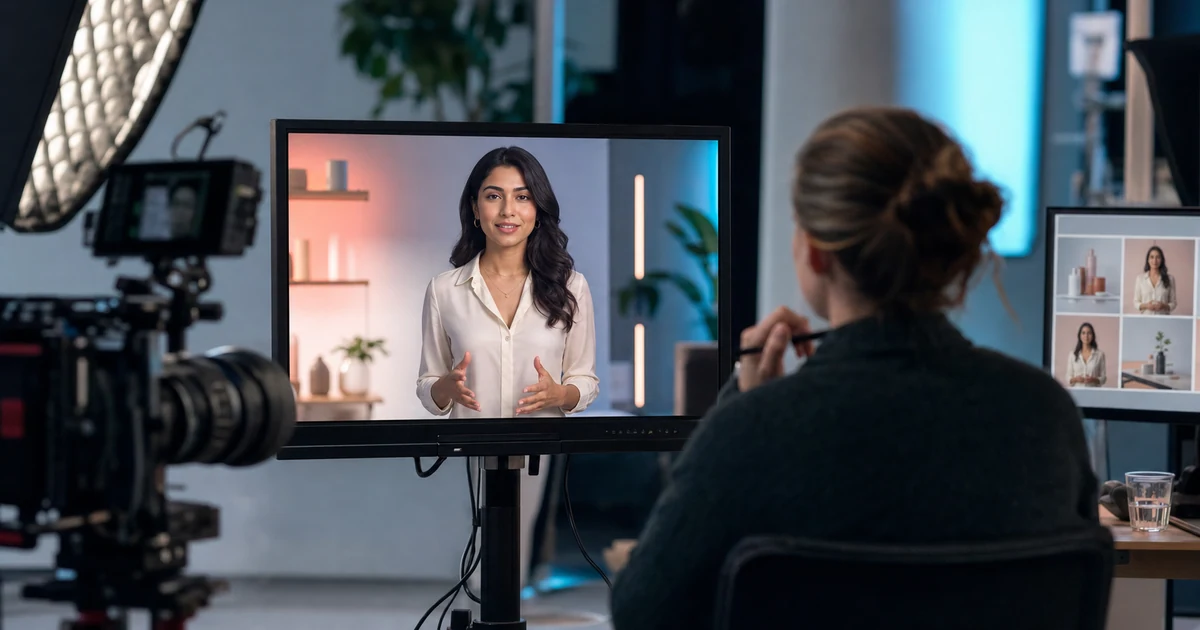
An AI spokesperson video puts a digital avatar presenter in your ad. The avatar looks into the camera, delivers the hook, walks through the product, and closes with a call to action. It reads like a person filmed it. Nobody did.
The presenter can be a stock avatar from a library, a custom avatar built from reference footage, or an existing clip re-voiced and lip-synced into another language. The output is a vertical clip built for Meta and TikTok placements.
This is not text-to-video. Text-to-video generates cinematic or abstract footage from a prompt. Spokesperson video is presenter-led: a face, a voice, a structured message, and your product on screen.
Why Are Brands Switching in 2026?
Three things lined up.
Model quality crossed the threshold. Lip sync, voice synthesis, and background generation all improved to the point where the output no longer reads as obviously synthetic on a mobile screen at normal scroll speed. That's the bar that matters — paid social is consumed in two-second glances, not on a studio monitor.
Creative fatigue got faster. Meta and TikTok punish ad sets that run the same creative too long. Teams that rotated three or four ads a month now plan for roughly ten to twenty variations to keep CPAs flat — a working rule of thumb many media buyers use, not a published platform number. No small team can source that from human creators every month.
The cost gap stopped being ignorable. Freelance creator clips are typically quoted somewhere between $150 and $500 each — treat that as a market range, not a fixed price. An AI spokesperson clip generates in one session for a few dollars. When the difference is two orders of magnitude, the question changes from "is the avatar as good?" to "is it good enough for this specific job?" For hook testing, the answer is usually yes.
What Does It Replace — and What Doesn't It?
It replaces the hired presenter wherever the job is delivering information clearly and holding attention. Hook ads, product explainers, before-and-after stories, feature callouts, unboxing walkthroughs — an AI presenter handles all of these.
It does not replace real social proof. A customer describing a real experience carries weight an avatar can't fake. If your product sells on trust and testimonial, keep real people in that slot.
The split most brands land on: AI spokesperson video for volume and variation, real creators for hero content and testimonials. That lets you test hooks at scale without burning creator budget on experiments. The same logic applies to UGC-style ads — AI covers the testing layer, humans cover the trust layer.
How Does the Production Workflow Work Now?
The old workflow: brief a creator, wait, receive footage, edit, export, upload. Four to seven days. One deliverable.
The current workflow: paste a product URL, pick an avatar and style, generate. One session. Multiple variations.
On v4v, the URL does the heavy lifting. The system pulls the product name, description, and key details from the page, builds a creative brief, and attaches it to the avatar and style you choose. No script writing. The output is a directed vertical ad — 9:16 at 720p, the native shape for Meta and TikTok feeds.
The avatar layer runs on Kling AI Avatar lip sync. Need the same ad in Spanish, German, or Japanese? HeyGen v2 translation localizes the audio and corrects the lip sync across 175+ languages without re-recording anything.
The piece that changes the economics most is the workflow layer. Build the pipeline once for a product — brief, avatar, style, format — and rerun it with a different hook angle or presenter without starting over. Products, avatars, and styles stay connected across sessions, so variation two takes minutes, not another setup.
What Does It Cost Compared With Hiring Talent?
Checked against public pricing pages in July 2026:
| Option | Pricing (as of July 2026) | What you get |
|---|---|---|
| Freelance creator | Typically quoted $150–$500 per clip | One deliverable, 3–7 days turnaround |
| HeyGen | $29–$149/mo (Creator to Business); Avatar IV listed at 20 credits/min | Polished avatars, scripts written by you |
| Synthesia | From $29/mo for 120 video minutes/year | Training-style avatar video |
| v4v (Seedance 2.0, 8s) | 349 credits ≈ $2.44 at the $7/1,000 entry pack | URL-to-ad workflow, no subscription, credits never expire |
The subscription platforms are credit-metered too. HeyGen's Creator plan includes 600 credits a month at $29, and Avatar IV generation is listed at 20 credits per minute — the monthly fee is the floor, not the ceiling. Synthesia's Starter plan meters output at 120 video minutes per year. Both are built around scripted presenter video, not product ads; there's no product-URL automation on either, so every video starts from a blank script. The full breakdown is in our v4v vs HeyGen comparison.
At $2.44 per 8-second clip, ten avatar variations cost about $24 — less than a fifth of the low end of a single creator booking. For the wider market picture, see what AI product video actually costs in 2026.
Which Avatar Style Fits Which Ad?
Talking-head hooks fit direct-response ads where the first two seconds decide everything. The avatar addresses the viewer, names the problem or the offer, and pulls them into the next frame.
Product-adjacent presenters fit demonstration ads. The avatar narrates while the product stays visible — overlaid on a product scene or cut against product footage.
Translated presenter clips stretch one production across markets. One English ad becomes five localized ads with translated audio and corrected lip sync.
Consistency across a campaign matters more than it used to. When the avatar, palette, and tone hold steady across ten variations, the campaign reads as one brand instead of ten disconnected tests. Persistent assets — products, avatars, and styles that stay linked between sessions — make that practical without a tracking spreadsheet.
Where Does an AI Spokesperson Still Lose?
Honest list. Five places.
Real testimonials. An avatar cannot vouch for your product. Social proof formats still convert better with real customers, and faking them is both ineffective and a policy risk.
Generic avatars read as generic. If ten brands use the same stock presenter, the ad looks like an ad. Differentiation has to come from the hook, the product context, and the style — the avatar alone won't carry it.
Voice quality varies. Text-to-voice ranges from natural to flat depending on the model and the script. Short, punchy scripts with natural sentence rhythm survive synthesis far better than dense copy.
Disclosure rules are tightening. Meta and TikTok both require AI-content disclosure in certain ad formats, and the requirements keep expanding. Build the disclosure step into your workflow now.
Polish ceilings exist. If you need one recurring branded presenter with maximum realism, HeyGen's custom digital-twin avatars are genuinely strong, and Synthesia remains the steadier pick for long-form training video. And v4v's URL-to-ad flow currently outputs 720p — the right resolution for a phone feed, not for a 4K brand film. For clip work at higher resolution, Gemini Omni in the v4v Lab goes up to 4K, but the Studio flow itself is 720p today.
How Do You Make It a Repeatable System?
The brands getting the most out of this format aren't producing one ad. They're running a testing loop.
Define three to five hook angles for a product. Produce one avatar variation per angle. Run them against each other on a small budget. Find the winner. Then produce five to ten variations of that angle. Repeat monthly.
That loop only works when production is fast and cheap. It dies if each video takes three days and $300. It lives when a variation costs a few dollars and generates in a session.
The saved workflow is what removes the friction: open the tool, pick the hook angle, generate. Brief, avatar, and style are already configured from last time. The system produces ads; you spend your attention on which angles to test next.
Paste a product link. The brief builds itself.
Generate avatar-led product ads and hooks in about 5 minutes.
Try v4vFrom $7 · no subscription, ever · credits never expire
FAQs
What is an AI spokesperson video?
A video ad in which a digital avatar presenter delivers a spoken message to camera — the hook, the product pitch, the call to action. The avatar is generated by AI, not filmed. The format is used for product ads, explainers, and paid social creative.
How much does an AI spokesperson video cost in 2026?
On v4v, an 8-second clip generated with Seedance 2.0 costs 349 credits — about $2.44 at the $7-per-1,000-credit entry pack, with no subscription and no credit expiry. Subscription platforms run $29 to $149 per month as of July 2026 (HeyGen, Synthesia), and human creator clips are typically quoted in the low hundreds of dollars each.
Do AI spokesperson ads have to be disclosed as AI-generated?
Meta and TikTok both require disclosure for AI-generated or synthetic content in certain ad formats, and the rules keep expanding. Check each platform's current policy before launch and build the disclosure step into your production workflow rather than retrofitting it.
Can one AI spokesperson video run in multiple languages?
Yes. Translation models like HeyGen v2 — available inside v4v — localize a finished video into 175+ languages by replacing the audio and correcting the lip sync. One production becomes several market-ready versions without reshooting.
When should I still hire a human presenter?
For testimonials, founder stories, and hero brand content. A real customer describing a real experience carries trust an avatar cannot fake, and platforms increasingly reward that authenticity. The working split: AI presenters for volume and hook testing, real people for social proof.
Updated July 18, 2026 · Facts checked July 31, 2026. Competitor claims from public pricing pages; verify before relying on them.