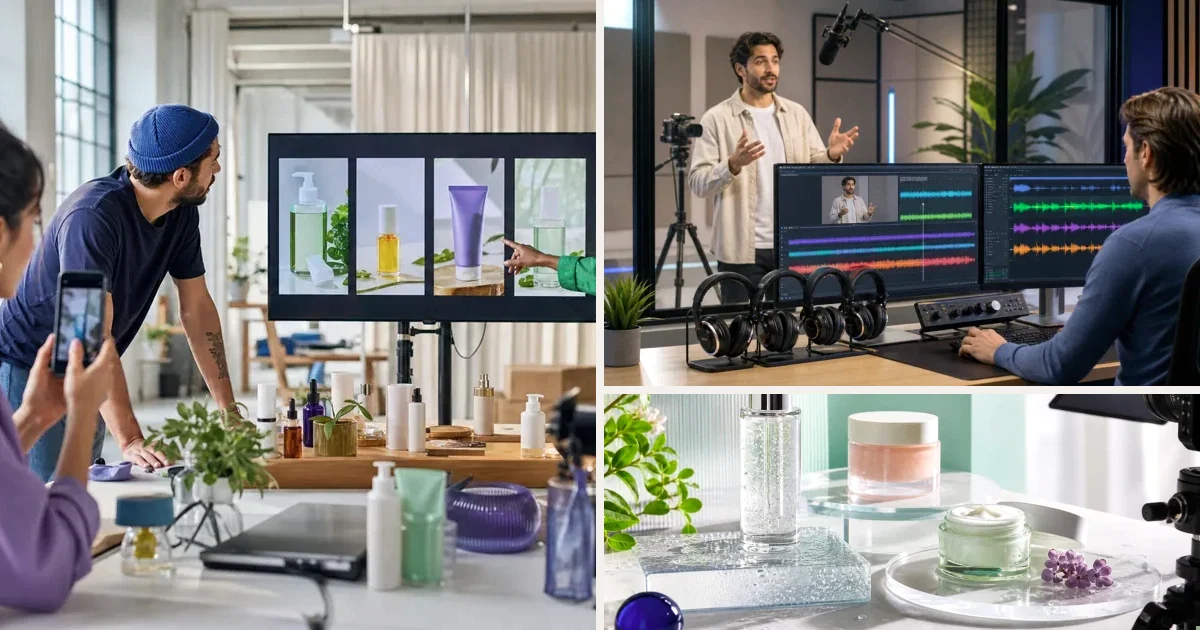
This is an illustrative scenario — a documented walkthrough of the workflow, not a named-customer case study. It shows how a small ecommerce team could produce 50 product video ads in five working days: products imported by URL on day one, formats and hooks batched on days two and three, variants and localization on day four, QA and export on day five — roughly $125 in credits total. The point isn't the number; it's that volume is a workflow property, not a headcount property.
- The Setup: A Small Team, a Big Creative Backlog
- The Workflow: URL to Finished Ad
- Day 1: Building the Creative System
- Days 2 and 3: First Batch of Ads
- Days 4 and 5: Variations, Translation, and Music
- The Numbers
- What Made the Difference
- What This Means for Testing Velocity
- Agencies and Multi-Client Operations
- FAQs
- Start With One Product
Most DTC brands hit the same wall. Ad creative takes too long. Testing slows down. ROAS suffers — not because the product is weak, but because the team can't produce enough variations fast enough to find what works.
This is a documented scenario showing how a small e-commerce brand used v4v.ai to produce 50 product video ads in five working days: what the workflow looked like, what it cost, and what actually made it work.
The Setup: A Small Team, a Big Creative Backlog
The brand sells skincare products direct-to-consumer. Two-person marketing team. Around $15,000 per month in ad spend across Meta and TikTok. The problem was familiar: six SKUs ready to test, but only two or three video ads per product. Not enough variation to run real creative testing.
Their previous process meant briefing a freelance editor, waiting three to five days per batch, and paying $150 to $400 per finished ad. At that rate, 50 ads would run $7,500 to $20,000 and take four to six weeks.
They needed a different approach.
The Workflow: URL to Finished Ad
The team started with v4v's Product to Video workflow. Paste a product URL, and the system pulls product data, generates a creative brief, attaches avatars and assets, and runs the directed video workflow. No manual scripting. No hunting for images separately.
Day 1: Building the Creative System
Day one was setup. Each of the six SKUs got its own product profile inside v4v. Avatars were selected per product category. Brand styles were attached.
That took about two hours — and they only did it once. Products, avatars, styles, and assets stay connected inside v4v's persistent creative system. Every subsequent generation pulls from the same setup. Nothing rebuilds from scratch.
Days 2 and 3: First Batch of Ads
With the creative system in place, they started generating. Each run used the ecommerce workflow. Output: 9:16, 720p vertical video — native format for TikTok and Instagram Reels.
Using Seedance 2.0 as the primary model, an 8-second video costs approximately 349 credits. At the 10,500-credit pack ($70), that's roughly $2.33 per video. They also ran variations through Kling 3.0 and Veo 3.1 via the AI Lab to get different visual styles on the same products.
By end of day three: 28 finished ads across four SKUs.
Days 4 and 5: Variations, Translation, and Music
The second half of the week was about variation and localization. HeyGen v2 translation — built into v4v — produced Spanish-language versions of top performers for a Meta campaign targeting US Hispanic audiences. No separate platform. No export-and-re-upload loop.
Suno music generation added background tracks where ads needed audio lift. Kling AI Avatar lip sync handled voiceover matching.
By Friday afternoon: 50 ads. Six SKUs. Multiple languages. Multiple visual styles.
The Numbers
| Metric | Traditional Freelance | v4v Workflow |
|---|---|---|
| Time to 50 ads | 4 to 6 weeks | 5 days |
| Cost per ad | $150 to $400 | ~$2.33 to $3.50 |
| Total cost (50 ads) | $7,500 to $20,000 | Under $175 |
| Revisions | Billed separately | Regenerate from same brief |
| Format | Varies | 9:16, 720p, paid social-ready |
Total credit spend for the week came in under $175. That covered ads generated with Seedance 2.0, Kling 3.0, and Veo 3.1, plus translation and music runs.
No subscription required. They bought a 10,500-credit pack for $70, topped up once with a 5,100-credit pack at $35, and still had credits left at the end of the week.
What Made the Difference
Three things separated this from a typical AI video experiment.
The brief builds itself. Writing the brief is usually the biggest time sink in any creative workflow. v4v pulls product data from the URL and generates it automatically. The team never wrote a single script line.
The creative system persists. Because products, avatars, and styles stay connected, generating ad number 40 takes the same setup as ad number one. There's no rebuilding.
Everything runs in one workspace. Jumping between a video generator, a translation tool, a music platform, and an image editor adds hours of friction. With Seedance 2.0, Kling 3.0, Veo 3.1, HeyGen v2, Suno, and lip sync all inside v4v, the team stayed in one tab the entire week.
What This Means for Testing Velocity
Fifty ads in one week means fifty creative hypotheses ready to test. That's not just a production win — it changes how you run paid social.
More variations mean you can test hooks, formats, avatars, and product angles at the same time. Winners surface faster. CPM data comes in sooner. ROAS improves because you're not running the same three creatives into fatigue.
For a brand spending $15,000 per month on ads, faster creative iteration is directly tied to return. The entire v4v credit spend was less than 1.2% of their monthly ad budget.
Agencies and Multi-Client Operations
The same workflow scales for agencies. If you manage five to ten brand clients, v4v's Workflows feature lets you build a reusable production pipeline. One prompt structure becomes a repeatable system across client SKUs — no rebuilding the brief, the avatar setup, or the asset connections for each new project.
Paste a product link. The brief builds itself.
Generate product videos, UGC-style ads and hooks in about 5 minutes.
Try v4vFrom $7 · no subscription, ever · credits never expire
FAQs
How many video ads can you realistically generate in one day using v4v?
It depends on the models you use and how much variation you need. With the ecommerce workflow and Seedance 2.0, a single operator can generate 10 to 15 ads per day once product assets are set up. After day one, setup time drops to near zero — the creative system is already built.
What does it actually cost to produce 50 video ads with v4v?
At approximately 349 credits per 8-second video using Seedance 2.0, 50 ads runs around 17,450 credits — roughly $116 at the 10,500-credit pack rate of $0.00667 per credit. Add translation, music, and variation runs and you're still well under $200 for the full batch.
Do credits expire if you don't use them quickly?
No. v4v credits don't expire on a billing cycle. Top up once, spend as needed. That's a direct contrast to platforms like Creatify, where credits reset every two months whether you've used them or not.
Can you produce ads in multiple languages inside v4v?
Yes. HeyGen v2 translation is part of the model stack inside v4v's AI Lab. Translate finished video ads without leaving the platform or exporting to a separate tool.
Is v4v suitable for brands running ads specifically on TikTok?
The output format is 9:16, 720p — native vertical for TikTok, Instagram Reels, and Meta vertical placements. The ecommerce workflow is built for paid social, not broadcast or horizontal formats.
What's the difference between v4v and Creatify for product video ads?
Creatify offers product URL analysis and a large actor library, but quality videos on their Starter plan cost $8 to $15 each and credits expire every two months. v4v charges per credit with transparent, fixed per-second model costs and no expiry pressure. It also includes a connected multi-model pipeline — video, image, music, translation, and lip sync — in one workspace. Creatify doesn't offer that.
Do you need video editing experience to use v4v?
No. The ecommerce workflow handles the full pipeline from URL to finished ad. For more direct control, the AI Lab lets you run individual models. Neither requires editing skills or technical setup.
Published July 14, 2026 · facts as of publication.